Constructivism, Design, Cybernetics: Radical, Social, 2nd Order

Larry Richards gives a paper at the Cybernetics Conference

By Mark Enslin

The School for Designing a Society co-hosted the 2007 meeting of the American Society for Cybernetics, from March 30th to April 1st. Unlike its other professional meetings, which typically are hosted at universities or chain hotels, this was in the Urbana-Champaign Independent Media Center in downtown Urbana. The UC-IMC is also an arts and community center: it houses various projects, and offers the challenge of distinguishing and connecting idiosyncratic shared spaces, which for this meeting I preferred to the challenge of drawing distinctions and establishing connections in generic spaces poised to erase them.

The theme of the conference, “Constructivism, Design, Cybernetics: Radical, Social, 2nd Order”, was deliberately formulated to encourage the creation of a three-way bridge spanning the thought and practice of:

  • radical constructivism – that the reality we describe and perceive arises from our manner of living as perceivers and describers;
  • social (architectural, artistic) design – deliberate and improvised actions and structures that define and perturb what we call the social (aesthetic), and what we distinguish as their consequences;
  • (second-order) cybernetics – an interdisciplinary weave of intellectual pathways connecting feedback, circular causality, self-organization, self-reference, cybernetics of cybernetics, taking ourselves into account.

There were performances, presentations, demonstrations, and conversations. Once and future participants in SDAS, from Montreal, Richmond, Urbana, Vancouver, Baltimore, Northampton, Minneapolis, Olympia, the Hudson Valley presented, performed and manifested their presence. There was a full-length play reflecting on pictures on stage, on writing plays, on 16 Republican senators barely visible in the smoke-filled room, Judy Lombardi shows a video of Humberto Maturana speakingall delivered by a single actor in an easy chair, in words constructing that which was reflected on. There was a lecture on the history of the screw, with chorus, would-be director, and heckler. There was a report on how working in a community theater could lead to questioning of assumptions about where the self and volition begins and ends. Susan Parenti presented a position paper which reformulates the problems of U.S. Health Care system as a design project.

‘Radical’ clashed with ‘moderate’. A connection between the terms of a circular description of life from Humberto Maturana’s autopoeisis and the discourse of power and privilege was offered. The US health care system, the criminal justice system, ecosystems, systems of organized violence brushed up against cybernetic descriptions of system. Socio-linguistics of cell phones and of expertise were staged and questioned. A house theater showed how mouth sounds make a world, walk us through that world, and present and make choices when that construction talks back.

Judy Lombardi gave two presentations with titles named after Herbert Brün’s ideas: (1) Violence is a Message, and (2) Floating Hierarchies. She supplemented her talks with video clips of Herbert Brün and Humberto Maturana. The following clip is presented with her permission.

1994 – Herbert Brün clip (8 minutes)
Video credit: Judy Lombardi, LCSW-C, Ph.D.

Peace is a Need by Herbert Brün

Video -WMV | Video -QT | Video part 1 | Video part 2 -Java

Exerpt from the video of Herbert Brün

“If you investigate the sentence structure of our daily discourse, including the media and also our own domestic talk, including sentences said repeatedly in situations of schools, teaching, and so forth, you’ll find that every time the term “peace” is mentioned it’s a kind of a consequence. You have to do something so that there be peace. Or you better do that otherwise there won’t be peace. So peace is described as something that has to be acheived, which you have to find, which you have to make.”

“Imagine we would say the same thing about hunger. What do you do in order to have hunger? Do you try to acheive hunger, or do you feed? People who aren’t fed will never be hungry again. In order to have hungry people, you have to give them food. If we could declare “peace” to be one of the needs … it would give us a different english language. We would understand, for instance, that we need peace, and since we need peace we have to meet it with our conflicts. We have to meet it with our differences. Not so that there be war but so that the need for peace be satisfied. So peace is not to ward off conlflicts and to avoid all controversy and confrontation. To the contrary: we have to learn language … which does not assume peace to be a reward, but as a condition for conflict. That is, the desirability of conflict has to be celebrated so that it can meet peace.”

-Herbert Brün
Posted in Cybernetics, Project Report, Video

Emphases

Microtonal Design, or Alternative Crystallizations of the Pitch Continuum No aspect of music has become more rigidified in our minds and practice than the potential of musical pitch. Out of the vast pitch continuum, we find ourselves making the same non-choice over and over again: 12 equal divisions of the octave. Are alternatives possible, and do they make any sense? Yes! Join us for an exploratory seminar at the School for Designing a Society in Urbana, Illinois. Expertise unnecessary; only a willingness to un-stick yourself in good company.

Cybernetics and Social Change Cybernetics as an interdisciplinary field of study was proposed in the 20th century by scientists who wanted to fight fascism. From this study there ensued various unexpected theoretical and practical attempts and tendencies. A starting point for this course will be the view of cybernetics as a praxis for generating radical projects. Radical: getting at the roots of a problem; changing whole frameworks. The questions of cybernetics—regulation, self-regulation? observation, self-observation? stability, dynamics?—are invited to help actively answer the questions of social change: which social? how change?

Liberation Ecology What does sustainability look like when it refuses to sustain white supremacy? What is the meaning of liberation in a civilization that cannot feed or fuel itself? The choice between ecological objectives and social objectives is lose-lose. Rather than make it, we can unveil the connections between the two sets of issues, and create strategies for change that build on those connections. This class will weave together two elements: principles of ecological design, and exploration of the relationship between real and desired ecosystems and real and desired societies.

Ongoing Composition/Performance Projects

Pester Power! A collaborative compostion made by SDaS 2013-2014, now a kid’s performance to empower adults to help them change the world.
Collaboration with writer Faranak Miraftab and her book Making a Home in the Heartland: Immigration and Global Labor Mobility We’re in the process of creating a touring program based on this book.
“My Work in the Light of Herbert and Marianne Brun” Presentation/workshop series by local and visiting artists and activists.

Who is invited?

Since we all live with the consequences of the current design of society, everyone is invited to participate in designing a different one. No particular educational background is required; the prerequisite is the desire to participate in designing a society.

Apply

To apply to participate in the School for Designing a Society, please click here and you will be contacted for a phone interview.

To contact admissions, email Melanie at applications@designingasociety.net.

Keep in Touch! Subscribe to our Newsletter.

apply no particular educational background is required; the prerequisite is the desire to participate in designing a society.

register fill out the registration form here.

Keep in Touch! Subscribe to our Newsletter.

To Join a Climate Action

How do I sign up? What do I do?

1. Contact Linda at 217-550-6189 or lindaturnbull800@yahoo.com to schedule the first meeting of your team with a live performance of Pester Power at a time convenient for you and your neighbors.

2. Invite your neighbors to your house, to meet and see the live performance. (It’s 25 minutes long, fun, performed by kids).

3. After the performance, participate in a discussion about ways you and neighbors can change environmental and racial climate in your own home and in your community over the next 1 to 2 months (a member of Urbana’s Sustainability Advisory Commission would be happy to help). Make a commitment to take certain steps from the Low Carbon Diet book.

4. Meet three more times with your neighbors to check in on your action plan.

5. Celebrate your success with your team and with other teams.

Does this cost anything?

No. The performers (all kids) are excited to empower you adults to help them to change the world! The Urbana Sustainability Advisory Commission is delighted to work with you.

Keep in Touch! Subscribe to our Newsletter.

Seminars and workshops meet regularly… we’ll keep you updated!

apply no particular educational background is required; the prerequisite is the desire to participate in designing a society.

upcoming read about our upcoming programs and workshops for the year.

touring read about our touring and performance schedules for the year.

courses listed both alphabetically and by topic & a number of interdisciplinary programs cross boundaries between disciplines.

what happens? designing a society is a project that intersects the formats of classroom, commune, performance ensemble, activist group.

Stay in Touch

Keep in Touch! Subscribe to our Newsletter.


Exuberant Performance Workshops

Create your own One Woman (Man) Band!: Learn to multi-play various musical instruments.
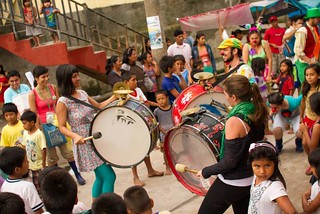
Waltzing Marching Band Take to the streets with a big band full of unusual instruments.
Vaudeville, not Awed-ville Going back to the 1930’s, learn to be a performative ‘jack/jill of all trades’, rather than an expert in one.
One Man Band

Ongoing Composition/Performance Projects

Pester Power! A collaborative compostion made by SDaS 2013-2014, now a kid’s performance to empower adults to help them change the world.
Collaboration with writer Faranak Miraftab and her book Making a Home in the Heartland: Immigration and Global Labor Mobility We’re in the process of creating a touring program based on this book.
“My Work in the Light of Herbert and Marianne Brun” Presentation/workshop series by local and visiting artists and activists.

Who is invited?

Since we all live with the consequences of the current design of society, everyone is invited to participate in designing a different one. No particular educational background is required; the prerequisite is the desire to participate in designing a society.

Apply

To apply to participate in the School for Designing a Society, please click here and you will be contacted for a phone interview.

To contact admissions, email Melanie at applications@designingasociety.net.

Keep in Touch! Subscribe to our Newsletter.

Who is invited?

Since we all live with the consequences of the current design of society, everyone is invited to participate in designing a different one. No particular educational background is required; the prerequisite is the desire to participate in designing a society.

Apply

To apply to participate in the School for Designing a Society, please fill out the form here and you will be contacted for a phone interview.

To contact admissions, email Melanie at applications@designingasociety.net.

Keep in Touch! Subscribe to our Newsletter.

Who is invited?

Since we all live with the consequences of the current design of society, everyone is invited to participate in designing a different one. No particular educational background is required; the prerequisite is the desire to participate in designing a society.

Apply

To apply to participate in the School for Designing a Society, please click here and you will be contacted for a phone interview.

To contact admissions, email Melanie at applications@designingasociety.net.

Film Emphasis In the fall of 2013, the School for Designing a Society began to put more emphasis on the medium of video, with forays into the creation of Public Service Announcements as part of the larger SDAS collaboration project. We will continue with this emphasis in 2014. Under what circumstances will a composition of sound, text and moving image provoke curiosity, action, reflection, and change of mind?

Collaboration with writer & urban planner, Faranak Miraftab This Spring 2014 SDaS participants have been invited to work with writer and urban planner, Faranak Miraftab on theatricalizing texts from her book, Making a Home in the Heartland: Immigration and Global Labor Mobility. The book is based on interviews with Cargil employees in Beardstown illinois. The idea would be to create a touring program based on these texts/interviews. Writers, musicians, poets, dancers, activists are invited to work on this collaboration.

apply no particular educational background is required; the prerequisite is the desire to participate in designing a society.

upcoming read about our upcoming programs and workshops in the fall, spring & summer.

courses listed both alphabetically and by topic & a number of interdisciplinary programs cross boundaries between disciplines.

what happens? designing a society is a project that intersects the formats of classroom, commune, performance ensemble, activist group.