by Susan Parenti
3pm, May 27, Thursday in Olympia, Washington—Cool, rainy weather, deserted streets… Suddenly the friendly Olympia Community Center is swamped with a group that will swell into 122 people over the next three days—participants in the 2010 Thinking Outside the Box health care system design intensive.
 Where do they come from? A large number came from the U.S, but also from Canada, South America, Africa, Japan, Europe. Participants are health care providers, students, health profession services, complementary care providers and students, herbalists, mental health healers, community workers, clowns, designers, composers, city planners.
And what do they come to? The Thinking Outside the Box health care system design intensive is a four day working conference, organized by Patch Adams MD, the Gesundheit Institute, and by the School for Designing a Society. Its aim is to seed designs of a variety of local projects that move health care systems away from the corporate business context into models of compassion and service.
Yipes! “Models of compassion and service”?!? Can anybody do that?!?
Excuse me, this health care system doesn’t work!
Sorry, you can’t change it.
But the health care system doesn’t–
—Sorry, it can’t be changed—
—But it—
—Sorry, you can’t change it doesn’t work
But—
Sorry, you can’t change it doesn’t work sorry you—
Jabberwocky, anyone? (“Beware the Jabberwock, my son! / The jaws that bite, the claws that catch! / Beware the Jubjub bird, and shun / the frumious Bandersnatch!”)
The Thinking Outside the Box intensive attempts to be anti-jabberwocky and pro-change, and is organized on three levels: speaker sessions, design group work, and afternoons of ‘tremendous tries’.
Keynote speakers brought up an array of directions and models: Stephen Bezruchka, MD, “Do you want health or health care?”; Paula Murphy, DC: “My Ideal Clinic”; Martin Donohoe, MD: “Stories and Society”; Patch Adams, MD: “What’s Your Love Strategy?”; Carl Hammerschlag, MD: “Community Mental Health”.

Design groups—which are small working groups facilitated by a design teacher from the School for Designing a Society—used as their starting points the desires of the conference participants. Over the course of the four days, teachers and participants used ideas from the Designers’ Toolbox to transform these desires into working designs. Ideas included: false statements, formulation, framing, hierarchy, patient participation, metaphor, nesting, consequences , performance in everyday life.
Afternoons of the Tremendous Tries brought in 10 different design projects from across the globe, enabling conference participants to listen and engage in small group settings. with visionary doers. The design projects were: Ideal Medical practice; Karma Clinic; Olympia Free Herbal Clinic; Barrio Adentro; Children of Fire; Population Health; Olympia Free Clinic Planning Effort; Olympia Free Mental Health.
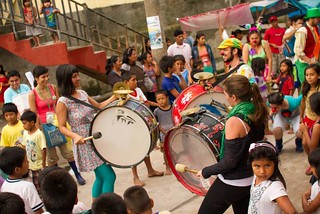
In between these sessions, there were performances in theater, music, and movement by the Health (s)Care System Theater Ensemble and Orchestra. These performers (students of the class Social Change, Design and Composition at Evergreen State College) offered a variety of creative critiques of the system as it is, and tender exposes of the system as it could be.
And to top it off, Patch Adams MD celebrated his 65 birthday on the second night of the intensive May 28th. A fabulous dance and music birthday party was organized for him in Seattle WA, and we all drove there and back and danced past midnight with Patch!
Throughout the four days, the need to radically change health care systems was connected to creativity and variety. Why?
 Calls for change in health care systems are, amongst other things, calls for creativity. The health care system crisis is a crisis of bankrupt ideas. We need a variety of new ideas, projects, designs, configurations, proposals—alternatives to look at and weigh. To address this need is one of the core aims of the health care system design intensive.
Why is there so little call for creativity and variety in relation to the health care system crisis? I consider it symptomatic of the stuckness of the situation and the identifying signature of those who consider themselves the players. Entrenched industry is not creative, nor is it looking for creativity (expensive technological innovations, yes). Rather, under the guidance of these ‘players’ the discussion of health care system change is pitched at the level of choosing between already available policy options within market capitalism.
While participants to the “Thinking Outside the Box intensive” came from all over the globe, there was a self-critique held in common. We obey a homogeneous culture of disease management (that continuously falls into corporate hands) instead of our creating and supporting a variety of cultures of health care.
Thinking Inside Meets Thinking Outside
The 2010 Thinking Outside the Box health care system design intensive is the 7th one we’ve offered over the last five years. The premise for the intensive is that our health care systems are fundamentally flawed. This means we need to think, and to think creatively, towards the design and implementation of systems we desire. The thinking that leads to desirable systems needs to be radically different from the thinking that leads to the current systems.
The intensives, and this premise on which they’re founded, have met a resistance over the past five years—interestingly, a rapidly changing one. This resistance is a portrait of the status quo thinking around health care systems.
For fun, and for historical reference points, I’d like to describe shifts of resistance to the Thinking Outside the Box Health Care System Design intensive.
2006: the first design intensive in Urbana Illinois. “Thinking Outside the Box” began in the context of Americans having been told for decades that we have the best health care system in the world. Thus, resistance to attending the design intensive: since we’ve been told that the US medical system is the best in the world, why should we redesign it?
2007: second design intensive in Harrisonburg Virginia. Resistance: ok, some people think that there are a few flaws in the US system. Let’s wait for the experts to fix those little itsy bitsy problems. Why should we REDESIGN it?
2008: third and fourth design intensives in Urbana Illinois and Hillsboro West Virginia. Resistance: Ok, we’ve just elected the people who will get the experts to fix it. I guess there are some big problems. Why should WE redesign it?
2009: fifth and sixth intensives in Baltimore Maryland and Hillsboro WVA. Resistance: Ok, the experts are fixing it. Let’s wait til they get the job done. We don’t need to redesign it.
2010: seventh design intensive in Olympia WA. Resistance: Huh. Err. Umm. We guess the experts fixed the health care system, but we don’t understand exactly what they did. Are things better or worse? Let’s wait for the experts to explain it to us. For now, we don’t want to hear anything more about health care systems, we’re sick of hearing about them. Been there done that. Say, how’s your golf?
On a personal note (but all this writing HAS been a personal note!) for me the 2010 health care system design intensive was the best of the 7 we’ve given. Why do I say that? Because I felt the most interest and concentration of attention from an assembled group of people on the ideas, projects and vocabulary that were being offered by speakers, presenters, visionary doers, and conference participants themselves. The excitement of people proposing new directions was met and matched by the excitement of people seeking new directions. Since I myself am both seeking and proposing, I met myself both coming and going in a circular loop of deliriously happy tizziness. I was so PROUD of everyone who participated, so liking myself in the presence of the event and the people. The health care system is NOT too big to change!
Representative Dennis Kucinich (Dem, Ohio) has long supported these intensives. He sent this special message to the 2010 intensive:
Twas brillig, and the slithy toves
Did gyre and gimble in the wabe;
All mimsy were the borogoves,
And the mome raths outgrabe.
“Beware the Jabberwock, my son!
The jaws that bite, the claws that catch!
Beware the Jubjub bird, and shun
The frumious Bandersnatch!”
He took his vorpal sword in hand:
Long time the manxome foe he sought—
So rested he by the Tumtum tree,
And stood awhile in thought.
And as in uffish thought he stood,
The Jabberwock, with eyes of flame,
Came whiffling through the tulgey wood,
And burbled as it came!
One, two! One, two! and through and through
The vorpal blade went snicker-snack!
He left it dead, and with its head
He went galumphing back.
“And hast thou slain the Jabberwock?
Come to my arms, my beamish boy!
O frabjous day! Callooh! Callay!”
He chortled in his joy.
’Twas brillig, and the slithy tove
Did gyre and gimble in the wabe;
All mimsy were the borogoves,
And the mome raths outgrabe.
—Lewis Carroll